
Why one hiring channel is rarely enough
Most Australian businesses default to one way of hiring. They post an ad, wait, and if nobody suitable applies, they post it again.
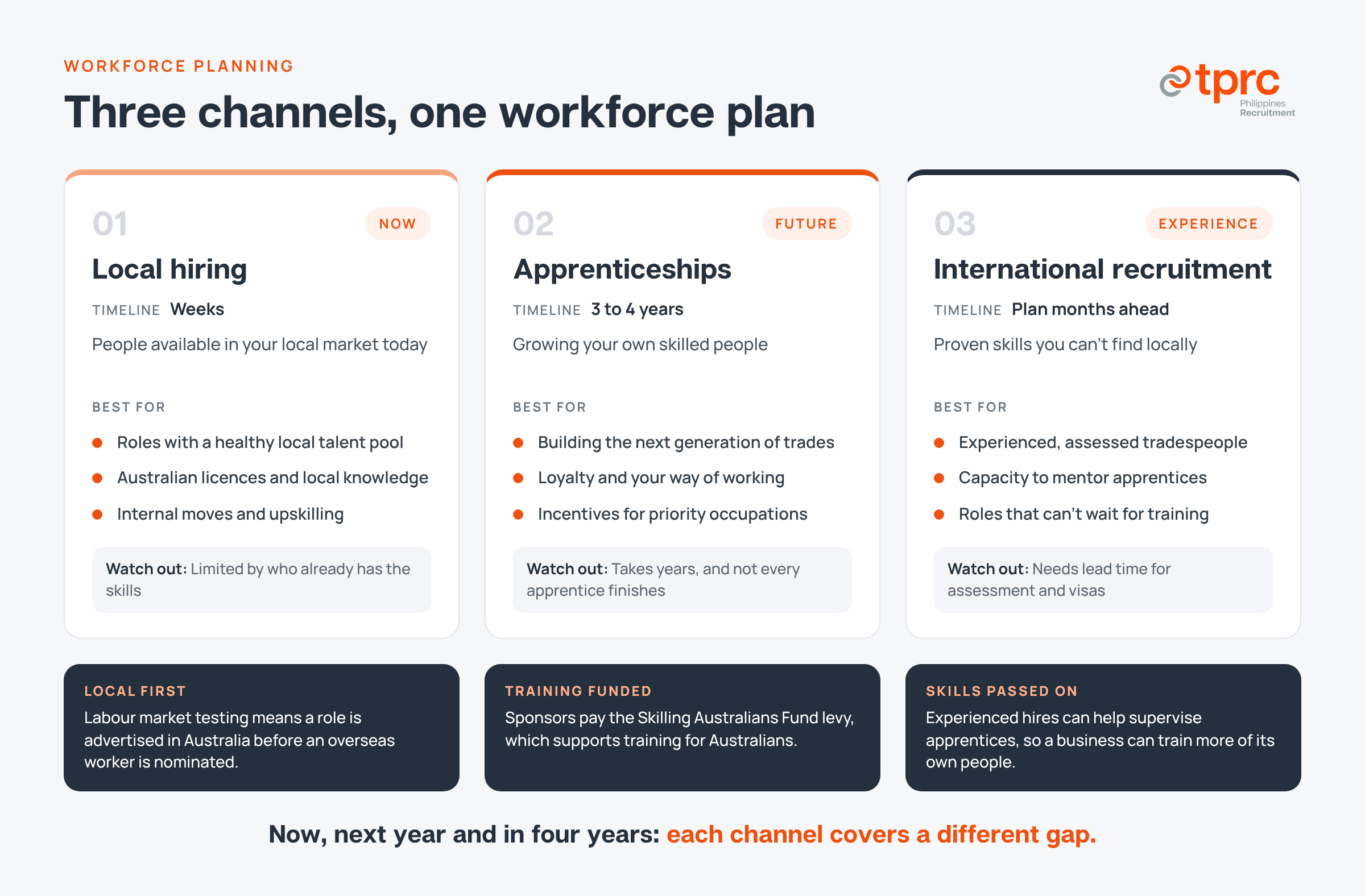
That approach still works for plenty of roles. But for skilled positions, the employers who keep their teams steady tend to use more than one channel at once: local hiring for people who can start now, apprenticeships for the skills they'll need in three or four years, and international recruitment for experienced people they can't find locally.
These aren't competing options. Each one solves a different problem, on a different timeline. This article looks at what each channel does well, where each one falls short, and how employers in automotive, mining, manufacturing, engineering, healthcare and logistics can combine them into one workforce plan.
What's actually making skilled hiring hard in 2026?
The overall labour market has cooled a little, but skilled roles are still hard to fill, and the main reason isn't a lack of applicants. It's a lack of experienced applicants.
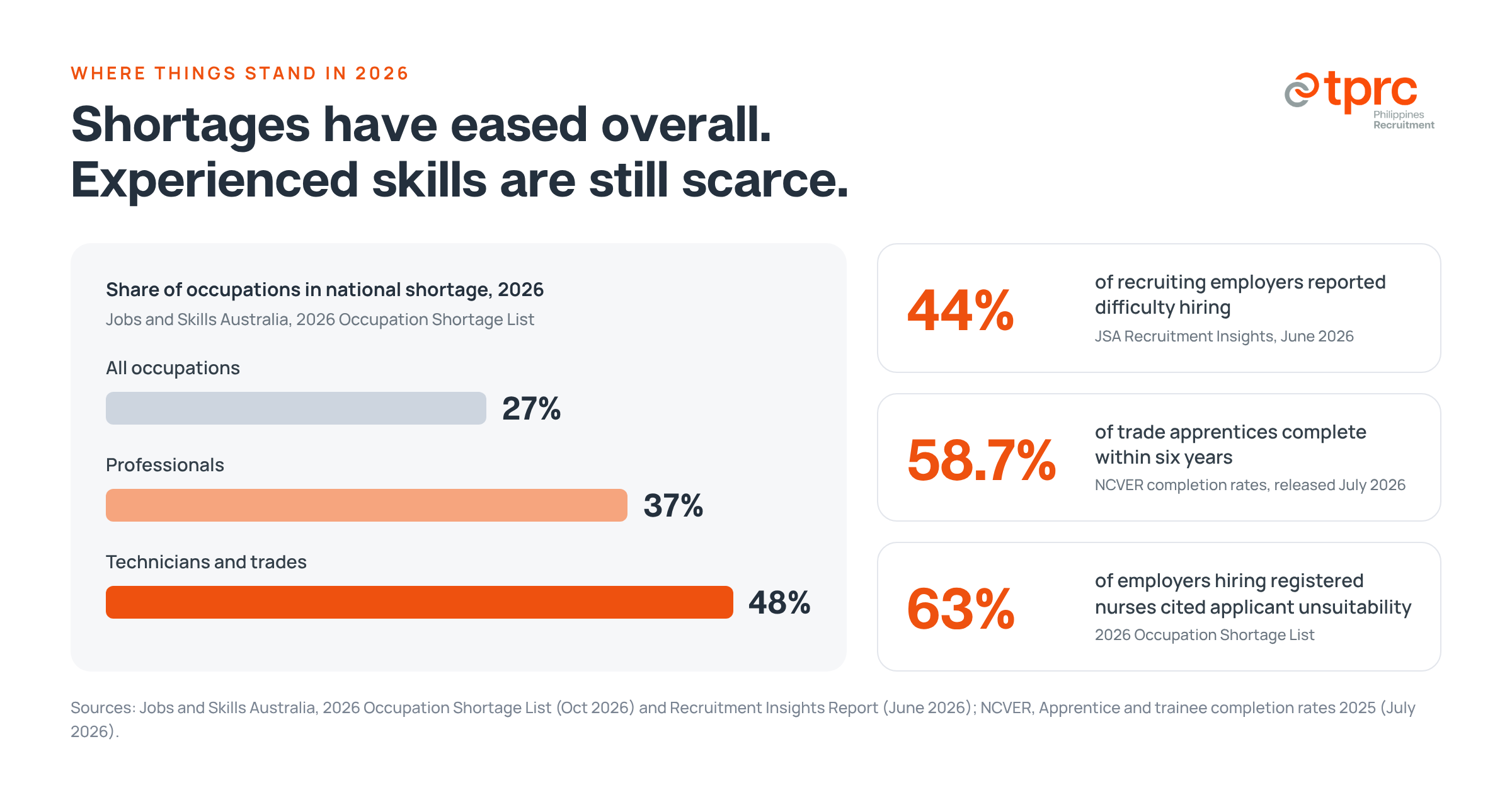
Jobs and Skills Australia's 2026 Occupation Shortage List found 27% of the 1,021 occupations it assessed were in shortage, down from 29% in 2025 and a peak of 36% in 2023. Underneath that improvement, 48% of technician and trades occupations and 37% of professional occupations are still in shortage (The Daily Aus, 2 Nov 2026).
The most common reason employers gave for shortages was applicant unsuitability, often a lack of experience. For registered nurses, 63% of employers cited it. Jobs and Skills Australia also notes that entry-level workers are finding it harder to get the jobs that build that experience in the first place.
Day to day, the pressure shows up in recruitment. In June 2026, 44% of recruiting employers reported difficulty hiring, and 41% couldn't fill their vacancies within a month (Jobs and Skills Australia, Recruitment Insights Report, June 2026).
That combination matters for workforce planning. When the gap is experience, posting the same ad again won't close it. You need a way to grow experience over time, and a way to bring it in when you need it now.
Local hiring: the first channel, and still the fastest when it works
Local hiring should always be the starting point. A local hire can often start within weeks, already holds Australian licences and tickets, and knows how things are done on Australian sites and workshops.
It's also the channel the rules expect you to use first. Before nominating a worker for a sponsored visa, employers must test the local labour market. For most nominations that currently means two advertisements, each running for at least four weeks, within the four months before the nomination is lodged (One Planet Migration Law, updated Nov 2026). In other words, overseas recruitment is designed to follow local recruitment, not replace it.
Where local hiring works best
- Roles where the local talent pool is healthy and you can afford a few weeks to fill
- Positions needing Australian-specific licences, local networks or immediate availability
- Internal moves: upskilling a capable team member into a harder-to-fill role, then backfilling the easier one
- Wider local pools that are easy to overlook, such as mature-age workers, career changers and people returning to the workforce, often reached through Workforce Australia
Where it falls short
Local hiring can only draw on people who already have the skills. When experienced candidates are scarce, as the shortage data shows for many trades, nursing and other professional roles, re-advertising can leave a role empty for months while the rest of the team absorbs the work.
Apprenticeships: building the workforce you'll need in four years
Apprenticeships are how a business grows its own skilled people. They build loyalty, pass on the way your business does things, and create the senior tradespeople of the next decade. No other channel does that.
But they take time, and not every apprentice finishes. NCVER's latest completion data, released in July 2026, shows:
- 43.1% of trade apprentices completed within four years, down from 46.7%
- 58.7% completed within six years, the measure NCVER recommends for trades
- Four-year attrition reached 42%, the highest in more than a decade
- Of trade non-completers, 81% were employed afterwards, but only 40% were still working in the same occupation
Source: Future Campus, 28 July 2026, reporting NCVER's Apprentice and trainee completion rates 2025.
The support available has also changed. From 1 January 2026, the Priority Hiring Incentive for employers of new full-time apprentices in Priority List occupations dropped from $5,000 to $2,500, paid over two years. A new Key Apprenticeship Program employer incentive of up to $5,000 applies to eligible occupations (Apprenticeship Support Australia, Dec 2025). Check what applies to your trades on the Australian Apprenticeships website.
What this means for employers
Apprenticeships are essential, but they're a long-term investment with real drop-out risk. They also need experienced people to supervise and teach them. When a business is short of senior tradespeople, it often can't take on as many apprentices as it would like, and the apprentices it has get less of the mentoring that keeps them in the trade.
International recruitment: bringing in experience when it can't be found locally
International skilled recruitment fills a specific gap: experienced people a business needs now, who aren't available locally and can't be trained up in time. A qualified heavy diesel fitter, an experienced automotive technician or a registered nurse with years on the ward can contribute from early on, and can help supervise and train others.
The visa system is built to keep this channel working alongside the other two, not instead of them:
- Local first. Labour market testing means the role has been advertised in Australia before a nomination is lodged.
- Fair pay. From 1 July 2026, new Core Skills nominations must meet an income threshold of $79,423, as well as the market rate for the role.
- Funding local training. Sponsors pay the Skilling Australians Fund levy at nomination: $1,200 per year of the visa for businesses with turnover under $10 million, and $1,800 for larger businesses. The levy was set up to fund skills training for Australians, so every sponsored hire contributes to the domestic pipeline.
Government settings point the same way. Permanent employer-sponsored places rose from 44,000 in 2025–26 to 58,040 in 2026–27 (Interstaff, citing Home Affairs planning levels). Since 19 September 2026, skilled visas in priority sectors such as construction, resources, healthcare and agriculture are processed first.
The trade-off is time. Sourcing, skills assessment, nomination, the visa and relocation all take months, so international recruitment works best when it's planned, not used as a last-minute fix.
How do the three channels work together?
Each channel answers a different question:
- Local hiring: who can we bring in now from the local market?
- Apprenticeships: who will we need in three to four years, and how do we grow them?
- International recruitment: where do we need proven experience now that we can't find locally?
The channels also strengthen each other. Experienced international hires can help supervise apprentices, which lets a business train more of its own people. Apprentices who complete become the local hires of the future. And because labour market testing comes first, local candidates get the first look at every sponsored role.
What it can look like by industry
The examples below are illustrations of how an employer might combine the channels. They're not client case studies.
|
Industry |
Local hiring |
Apprenticeships |
International recruitment |
|---|---|---|---|
|
Automotive (dealerships and independent workshops) |
Service advisers, detailers, tyre fitters |
First-year light vehicle and auto electrical apprentices |
Experienced technicians with diagnostic skills, who can also mentor apprentices |
|
Mining and resources |
Operators and site support roles |
Heavy diesel and electrical apprentices |
Qualified heavy diesel fitters and auto electricians for fleet maintenance |
|
Manufacturing and engineering |
Production and process roles |
Fitting, machining and fabrication apprentices |
Experienced fitters, machinists and welders for specialised work |
|
Healthcare |
Graduate nurses, support and admin roles |
Traineeships in allied health assistance and aged care |
Registered nurses with years of ward experience |
|
Logistics and transport |
Drivers, warehouse and dispatch staff |
Heavy vehicle mechanical apprentices |
Experienced heavy vehicle mechanics to keep fleets on the road |
The need is real across these sectors. In automotive, employers filled only 48% of vacancies in the Motor Trades Association of Australia's 2026 skills shortage survey. In healthcare, 63% of employers recruiting registered nurses cited applicant unsuitability, often a lack of experience (The Daily Aus, 2 Nov 2026). And tow truck drivers and tyre fitters were newly added to the 2026 shortage list..
How to build a three-channel workforce plan
You don't need a large HR team to do this. A practical plan for the next 12 to 24 months can come together in an afternoon.
- List your critical roles. Which three to five roles would hurt most if they sat empty for three months?
- Sort each role by timeline. Do you need someone in the next three months, the next year, or in three to four years?
- Check the local market honestly. How long did your last hire for each role take, and how many suitable applicants did you get? If a role keeps sitting empty, it's worth weighing the impact of skilled shortages on business growth.
- Match each role to a channel.
- Healthy local pool and short timeline: hire locally.
- Long timeline: take on an apprentice.
- Short timeline, scarce experience: plan international recruitment, and start early.
- Pair experience with training. Where you bring in an experienced worker, plan for them to mentor an apprentice too.
- Plan for retention, not just hiring. Onboarding, supervision and a clear path forward matter for apprentices and international hires alike. Our post on building a more sustainable workforce covers this in more depth.
- Review it every six months. Shortage lists, incentives and visa settings change, sometimes at short notice.
Our Workforce Assessment is a quick way to work through steps 1 to 4.
Where TPRC fits in
TPRC works with Australian employers on the third channel: finding qualified, experienced Filipino tradespeople and technical workers when the right skills aren't available locally. We place people across automotive, mining and resources, manufacturing, engineering, construction and agriculture.
Our process is built around getting the match right:
- Understanding the real requirements of the role before sourcing anyone
- Technical screening, trade testing and English assessment
- Reference checks and interviews, so you meet and choose your candidates
- Compliance support through sponsorship, nomination and the visa process, explained on our Work Visas & Migration page
- Onboarding and post-placement support once your worker arrives
We see international recruitment as one part of a wider plan. It works best alongside the local hiring and apprentices that keep Australian businesses strong. If you're new to sponsoring, start with how Standard Business Sponsorship works and the difference between 482, 186 and DAMA visas.
Frequently asked questions
Do I have to advertise locally before sponsoring an overseas worker?
In most cases, yes. Labour market testing generally requires two advertisements, each running for at least four weeks, within the four months before the nomination is lodged. Some exemptions apply under international trade agreements.
Does sponsoring an overseas worker help fund Australian training?
Yes. Sponsors pay the Skilling Australians Fund levy at nomination: $1,200 per year of the visa for businesses with turnover under $10 million, and $1,800 for larger businesses. The levy funds skills training for Australians.
What apprenticeship incentives are available in 2026?
From 1 January 2026, employers of new full-time apprentices in Priority List occupations can receive a Priority Hiring Incentive of $2,500, and a Key Apprenticeship Program employer incentive of up to $5,000 applies to eligible occupations. Check current eligibility on the Australian Apprenticeships website.
When does international recruitment make sense?
When you need experienced skills within the next 6 to 12 months, the local market hasn't produced suitable candidates, and the role can't wait for an apprentice to qualify.
Will hiring from overseas replace my apprentices or local staff?
It shouldn't. Used well, experienced international hires add capacity and can help supervise apprentices, so a business can train more of its own people.
Planning your 2027 team?
A workforce that holds up under pressure rarely depends on one hiring channel. If you're mapping out the skilled roles your business will need next year, talk to the TPRC team. We'll help you work out where international recruitment fits, and where local hiring or an apprentice might be the better call.